

TL;DR
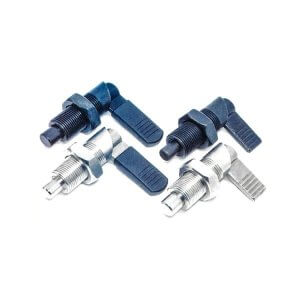
An indexing plunger is a positive-locking mechanism that requires manual retraction of a pin from a hole. A detent pin provides friction-based positioning by driving a spring-loaded ball into a shallow groove. Use indexing plungers for load-bearing or safety-critical positions. Use detent pins for low-force, frequent-cycle indexing where a little positional drift is fine.
The One-Sentence Difference (and Why It Matters)
An indexing plunger gives you a positive mechanical lock. A detent pin gives you a friction hold. That’s the whole distinction, and almost every selection mistake I see comes from blurring it.
Standardization bodies and manufacturers like JW Winco and Ganter sort these under separate norms (DIN 617 for indexing plungers, DIN 615 for spring plungers) because confusing the two introduces real mechanical risk. Drop a detent pin into a heavy-duty fixture and expect it to resist operator force, the part will slip. Spec an indexing plunger for a high-speed manual assembly jig and your operator will be exhausted by lunch from constant pin retraction.
Recommended visual: side-by-side cutaway diagram showing pin-in-hole vs. ball-in-groove.
How Each Mechanism Actually Works
An indexing plunger is a threaded body, a central pin, a return spring, and some kind of manual operating element. Knob, T-handle, pull ring, take your pick. To change positions, the operator pulls the knob to withdraw the pin from the mating hole. Most decent models offer a lock-out: pull the knob, twist it 30 degrees, and it seats in a locking notch that holds the pin retracted. Twist it back, the spring fires the pin forward, and you’re indexed again.
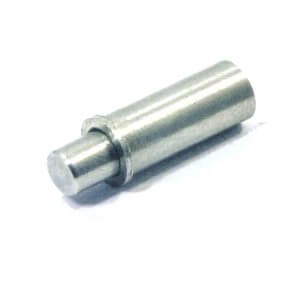 A detent pin (also sold as a spring plunger or ball plunger, depending on the catalog) is a body, a compression spring, and a ball or rounded nose. No knob. The ball just sits proud of the body. Slide a mating component past it and the ball is shoved back into the housing against the spring. When a groove lines up, the ball snaps into it. To reset, you push laterally, the ball ramps back up out of the groove, and the part slides on.
Recommended visuals: annotated cross-section for each component; comparison table covering actuation, locking behavior, and reset.
Holding Force — Where Detent Pins Quietly Fail
Detent pins are rated by initial pressure (force to start depressing the ball) and final pressure (force at full depression). These numbers are intentionally low. A standard KIPP K0309 ball-style spring plunger in an M10 (3/8-16) body lists initial pressure at 20 N and final pressure at 35 N. That’s it. That’s your holding force, and it’s direction-dependent and non-linear because it all comes down to a spring pushing a ball against a sloped groove.
Indexing plungers don’t work that way. Once the pin drops into the mating hole, holding force is the shear strength of the solid metal pin. An M10 indexing plunger typically uses a 6mm solid pin. Made from standard C45Pb steel (Re = 580 N/mm²), that 6mm pin handles roughly 13,120 N of shear before it deforms permanently.
So an M10 indexing plunger gives you something like 370 times the holding capacity of an equivalent M10 detent. That’s not a marginal difference, that’s a different category of part.
Recommended visual: bar chart contrasting 35 N vs. 13,100 N holding force.
Side Load, Shear, and the Failure Modes Nobody Talks About
Both parts fail. They fail in completely different ways, and mapping those failure modes is most of the selection job.
Detent pin failure modes. Wear, mostly. The ball cycles in and out of the groove, flattens slightly, the groove widens slightly, and the indexed position drifts. Side-load the pin past its final pressure and the ball just retracts into the housing. The mechanism releases when nobody expected it to. Anecdotally, in light fixturing I’ve seen drift become visible around the 200k-cycle mark, though that depends heavily on lubrication and the mating surface.
Indexing plunger failure modes. Because the pin physically occupies a hole, side loads go straight into the pin shaft. Exceed the yield (call it 13.1 kN for a 6mm steel pin) and the pin shears. Users in the AR-15 community have documented similar spring-loaded retaining pins shearing under shock loads, with the fractured fragments lodging in adjacent mechanisms and causing a hard lockup. Same physics in industrial fixtures.
The other failure mode worth flagging is the “stuck retracted” scenario. Return spring fatigues, or debris gets into the housing, and the pin never re-deploys. In machine guarding this is the dangerous one. The operator pulls the knob, walks away assuming the guard is locked, and the guard is actually free to move. Nothing visual tips them off.
Recommended visual: failure-mode table (mechanism → symptom → consequence).
The Decision Framework — 5 Questions That Pick the Part for You
- Is the position safety-critical or load-bearing? If a failure drops a load or exposes an operator to moving parts, indexing plunger. Not a debate.
- Does it need to hold against gravity, vibration, or operator force above ~50 N? Ball detents start slipping in that range. Move to an indexing plunger.
- Will it cycle more than 50,000 times per year? A manual station running 200 cycles a shift gets there. At that volume, knob retraction wears operators out. Lean detent. Schaeffler’s automotive detent bearing testing shows ball-in-groove mechanisms running past 1,000,000 cycles before significant raceway wear shows up, so the cycle life is there if the holding force is acceptable.
- Does the operator need one-handed actuation? If they can’t grab a knob, detent.
- Can you tolerate a little positional drift? Need rigid, repeatable position? Indexing plunger. If ±0.5mm is fine, a detent works.
Recommended visual: decision flowchart based on the five questions above.
Sizing, Mounting, and Spec-Sheet Literacy
The component itself is the easy part. The mating hole and the installation torque are where most of the field failures originate, and where the spec sheets bury the information that actually matters.
Mating hole prep. For press-fit spring plungers, manufacturers like Wixroyd call out an H7 tolerance on the receiving hole so the part installs manually without wobble. For ball detent pins, the receiving groove has to be chamfered. A 90° chamfer gives you an extraction force equal to the spring’s final pressure (1.0 × F). Drop that to a 60° chamfer and extraction force climbs to 1.732 × F. That ratio matters when you’re tuning a manual mechanism to feel right.
Now here’s the part people miss. When you’re mounting the threaded body of an indexing plunger, Elesa explicitly tells you not to chamfer the threaded mounting hole. The chamfer eats thread engagement and weakens the installation. Two different parts, two opposite rules about chamfers, and the rules live three product pages apart in most catalogs.
Installation torque. Over-torque a threaded body and you crack the housing or bind the spring. KIPP specifies 1.6 Nm max on an M6 (1/4-20) indexing plunger and 10 Nm on an M10 (3/8-16). Those are small numbers. A guy with a 3/8 ratchet and no torque spec will blow right past them without noticing.
Recommended visual: dimensional callout diagram pulled from a DIN 617 reference drawing.
Material, Coating, and Environment Match
Wrong material, short life. The grades to know:
- Carbon steel, zinc plated or black oxide. Standard for dry indoor automation. Class 5.8 body.
- AISI 303 stainless. Standard for food packaging and light washdown. Elesa’s PMT.110-SST line is built on this.
- AISI 316 stainless. For genuinely aggressive marine or chemical environments. Costs more, save it for when you need it.
- Hardened pin tips. Needed where the pin repeatedly hits a hardened fixture plate. Otherwise the pin mushrooms.
One thing that catches people with stainless indexing plungers: galling. Run an unlubricated AISI 303 pin into a stainless steel mating bore, and the two surfaces micro-weld and tear each other up. You’ll get a stuck pin in a few hundred cycles and a tech who can’t figure out why a “corrosion-proof” part seized.
Common Mistakes That Kill Service Life
- Substituting detents for locking pins. Trusting a 35 N spring to hold a 200 kg fixture against gravity is, frankly, a guarding violation waiting to happen.
- Over-torquing the threaded body. Putting 15 Nm into an M6 body rated for 1.6 Nm compresses the wall against the internal pin and binds the retraction permanently.
- Skipping the chamfer on the mating hole. Forcing a detent ball into a sharp 90-degree unchamfered hole shaves the ball surface and the part starts drifting inside 1,000 cycles.
- Wrong spring rate for the duty cycle. A heavy-duty detent spring on a station the operator actuates several hundred times a shift is an ergonomic problem dressed up as a strength problem.
FAQ Section
Can a detent pin be used as a safety lock?
No.
How do I know whether to match my application to initial pressure or final pressure?
Initial pressure is what’s holding the ball in the groove at rest, which is closer to your real-world holding force. Final pressure is the peak force needed to push the ball completely flush into the housing so the mating part can slide past. Most selection mistakes come from reading final pressure as the holding number, when in practice the assembly fails or slips well before you reach final pressure, because the ball starts ramping out of the groove the moment side load exceeds the initial pressure threshold. Use initial pressure for sizing if you care about when the mechanism gives, not when it gives up entirely.
What’s the typical lifespan of an indexing plunger vs. a detent pin?
A well-lubricated ball detent can clear 1,000,000 cycles because rolling friction generates very little wear. Indexing plungers usually need attention sooner, return spring fatigue, knob wear, or a sheared pin.
Can I substitute a heavy-duty detent pin for an indexing plunger to save cost?
The strongest M10 detents top out around 55 N. An M10 indexing plunger handles over 13,000 N of shear. They aren’t the same kind of part, and the cost delta is small compared to a fixture failure.
Author Bio:
The author Robin from rochemetal works in mechanical engineering and industrial hardware selection, with a focus on fixture design, component lifecycle analysis, and machine safety guarding.