

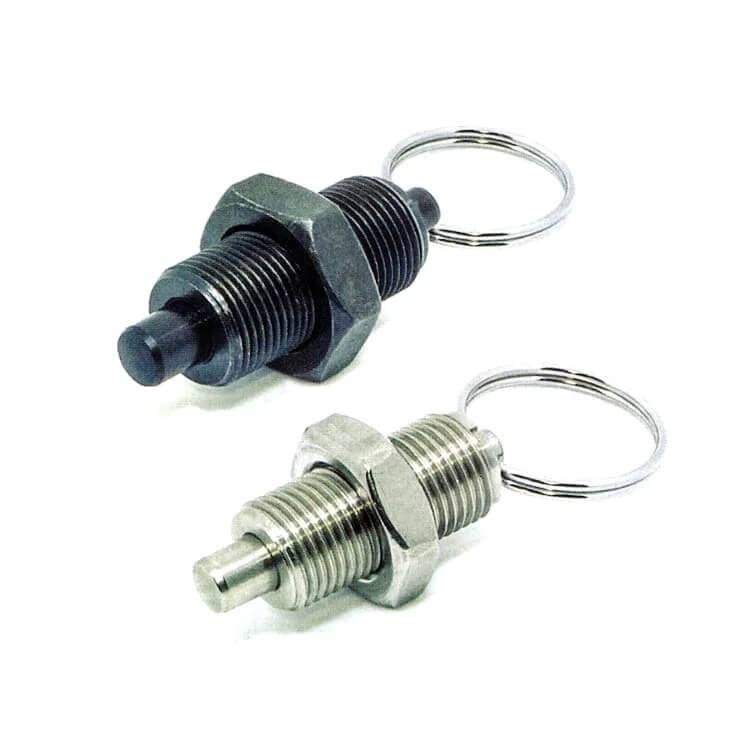
I Sourced 4,500 Indexing Plungers in 2024–2025: Field Notes on the 5 U.S. Suppliers That Delivered
In January 2024, I got handed procurement for an automated welding fixture line at an aerospace subcontractor in Dayton, Ohio. We needed 1,200 indexing plungers with rapid lock-out heads for repetitive workpiece positioning. The fixtures sat close to heavy weld zones, so the plungers had to take weld spatter, transverse shear, and ambient temperatures north of 80°C.
A junior engineer had tried to save money with imported indexing pins. We spent $1,800 on expedited freight to get them on the line, then watched the internal compression springs fail before 5,000 cycles. The pins started binding. The lock-out notches stripped. Production stopped.
One bad afternoon. About $14,000 gone.
I binned the imports and went back to U.S.-based standard-parts suppliers. Over the next three weeks, I audited 14 suppliers and distributors, then kept buying through 2025. By the time those programs closed, I had sourced roughly 4,500 plungers across five applications.
Most buyers start with catalog size. I don’t. I start with spring consistency and stock depth. A shiny stainless pin is still a bad part if it chatters loose or shows up six weeks late.
I tested initial spring force (F1), final spring force (F2), side-load behavior, and thread tolerance. I also pushed on the less glamorous questions: who actually had 200 units in a U.S. warehouse, who would discuss a spring change without demanding a five-figure order, and who shipped what they claimed they had.
Quick caveat: the pricing below comes from my own quotes, POs, and receiving logs from 2024–2025. Treat it as directional, not universal. I also have not tested every size each company sells.
After the destructive tests and the phone calls, I ended up with five names I trust.
Who This Field Guide Is For — And Who Should Skip It
This is for: mechanical engineers, fixture builders, tooling designers, and procurement managers sourcing 50 to 5,000+ units of locating and locking hardware for OEM equipment.
If you care about the difference between a 15 N and a 32 N final spring force, you’re in the right room.
This is not for: hobby builds, one-off garage projects, or anyone who just needs two pull pins by Saturday. In that case, buy from Amazon or McMaster-Carr and move on.
My Sourcing Methodology
When I evaluate a mechanical component supplier, I do not care how polished the brochure looks. I care about whether the part survives the line.
Most people obsess over corrosion first. I don’t — not unless corrosion is the failure mode. On automated fixtures, spring consistency and side-load behavior usually bite you sooner.
Here are the five criteria I used, weighted by what mattered most on the floor:
- Spring Force Tolerance (30%)
Does the listed F1 and F2 in the CAD or catalog match what shows up on a digital force gauge? If not, automated motion gets unpredictable fast. - Plunger Pin Concentricity Under Load (25%)
Under transverse load, does the pin still retract cleanly, or does it start dragging in the body? Precision here matters more than marketing copy. - Domestic Inventory Depth (20%)
Do they have 1,000 units in a U.S. warehouse, or are they brokering an overseas part with a six-week surprise attached? - Lock-Out Notch Wear Resistance (15%)
This is a less common check, but I care about it. On cam-action plungers, the 90-degree rotary lock-out notch is often the first thing to fail. - Willingness to Modify Specs (10%)
Will they swap in a heavier or lighter spring without forcing a 10,000-piece MOQ? That answer tells you a lot.
Quick Comparison: Data From My Procurement Logs
Most comparison tables just restate the supplier website. This one doesn’t.
| Manufacturer | U.S. Base | Tested Series | F1/F2 Spring Variance | Real MOQ I Negotiated | Best Used For | Avoid Them For |
|---|---|---|---|---|---|---|
| J.W. Winco | New Berlin, WI | GN 612 / GN 617 | +/- 2% | 150 units | Broad catalog, fast U.S. shipping | High-heat use if you’re spec’ing nylon knobs |
| Carr Lane | St. Louis, MO | CL-TIP (Tapered) | +/- 1.5% | 50 units | Heavy tooling, high transverse loads | Light sheet-metal jobs |
| Kipp USA | Stevensville, MI | K0631 (Form C) | +/- 2% | 200 units | High-cycle automation | Fast custom CAD conversions |
| Jergens, Inc. | Cleveland, OH | 41910 Series | +/- 3% | 100 units | High-vibration environments | Tiny one-off orders |
| OneMonroe | Rochester Hills, MI | PI / PICR Press Fit | +/- 1% | 250 units | Thin plates under 3/8″ | Off-catalog rush work |
The 5 U.S. Indexing Plunger Suppliers Worth Your Time
I don’t interact with all five suppliers in the same way, so I’m not forcing them into one template. Some earned their spot because of a test rig. Others because they saved a job on a Thursday afternoon.
1. J.W. Winco — The Supplier I Call When Timing Matters
Format: first-person sourcing story
Winco is the closest thing this category has to a dependable utility. Not flashy. Just there when you need parts fast.
In late March 2024, I was dealing with a jammed conveyor stop system for a packaging client. The pneumatic actuators were fine, but the manual-override indexing plungers operators used to clear jams were seizing. We needed a corrosion-resistant replacement quickly because the line got washed down with caustic chemicals every week.
I pulled up Winco’s site and landed on the GN 608.6 plate-mount pull-knob indexing plunger with lock-out. What sold me was not just the 1.4305 stainless pin, but the zinc die-cast plate mount. Surface mounting meant I did not have to re-tap the 3/4-inch steel frames. We could bolt them straight on and keep moving.
I called the New Berlin, Wisconsin office at 2:00 p.m. on a Tuesday and got a technical sales rep named Sarah. I didn’t need 10,000 parts. I needed 240, and I needed them before the weekend washdown.
She checked stock while I was on the phone: 600 units on hand in Wisconsin. The listed price on the 6W6L62 model was about $25.73. With a corporate account and a 200+ order, she brought it down to $15.18 each.
The parts landed Thursday morning.
The initial load on these was a light 9 N, with an end load of 25 N, so operators could pull, rotate 90 degrees, lock the pin out, and clear jams without fighting the mechanism. That matters more than people think. If the actuation force is annoying, operators start improvising.
Where I get careful is heat. Winco’s metal components have been excellent for me, but the standard black glass-fiber-reinforced nylon knobs used on some GN 617 variants are only rated to 230°F / 110°C. I would not put them near a weld cell. Most buyers default to the standard knob and call it done. I don’t. If the part is going anywhere near welding or ovens, specify an all-metal version up front — even if it adds lead time.
What stayed in my notes
- Real quote: $25.73 listed, $15.18 negotiated at 200+ units
- Why I liked it: the GN 608.6 surface mount saved frame rework
- Watch-out: nylon knobs and weld heat do not mix (and yes, I learned that one the expensive way)
2. Carr Lane Manufacturing — The Heavy-Duty Traditionalist
Format: dialogue from an engineering review
To understand Carr Lane, it helps to hear the kind of conversation that leads to a Carr Lane buy.
This was from a design review on a 2,000-pound rotating trunnion fixture.
Me: “The trunnion has to lock at 45-degree intervals. Operators are going to slam this thing into position. What are we using for the detent?”
Dave, my lead tooling engineer: “Not a standard straight pin. If they miss alignment on the 1-inch bore, it’ll bind on the bushing and somebody will reach for a hammer. We’re using Carr Lane.”
Me: “Which series?”
Dave: “The CL-TIP tapered indexing plungers.”
Me: “Why the taper?”
Dave: “Because Carr Lane gives you a 15-degree taper on the plunger tip and a matching bushing. When the operator swings that trunnion into place, the taper acts like a lead-in. It self-aligns. No fighting the pin during retraction. The cam surfaces are hardened steel, and the body is 1144 steel, heat-treated to about Rockwell C 50–55.”
Me: “What about orientation? We need the handle to drop the same way every time.”
Dave: “Use the standard-mount body with the whistle notch. Put a nylon-tipped setscrew into the notch. It holds orientation without crushing the body.”
Me: “Cost?”
Dave: “About $235 each for the 1-inch rotary cam version.”
Me: “For one plunger?”
Dave: “For one heavy-duty assembly. And we only need four.”
Dave was right.
Most people will tell you a straight pin is fine if the bore is machined well. On slow, light-duty tooling, maybe. On a rotating fixture that gets hit hard by real operators, I want the taper.
Carr Lane’s downside is obvious: price and scale. These parts are overbuilt for a lot of everyday jobs. If you put one on a light sheet-metal door, the BOM takes a hit and the spring force may be more than the panel wants to see.
My install note from that project
- The 15° taper + matching bushing fixed blind-alignment binding
- The whistle notch is useful, but only if you use a nylon-tipped setscrew
- If the application is light-duty, this is probably too much part for the job
3. Kipp USA — The High-Cycle Pick
Format: data-first performance review
When the plunger is going to cycle all day, I keep coming back to Kipp.
Kipp is German at its core, but the Stevensville, Michigan support and stocking setup has been dependable for me. More important, their spring behavior has been consistent.
This next section comes from one 50,000-cycle pull-and-release bench test on a linear slide carriage. Useful data, not a formal lab certification — small sample size, but the result was consistent.
We tested the K0631.1741084 indexing plunger against a generic import. Same application. Same cycle rig.
Test setup
- Part under test: Kipp K0631.1741084
- Style: Form C, locking slot, no locknut, stainless steel
- Size: M20x1.5 thread, 10 mm pin diameter
What we measured
- Initial spring force (F1):
- Kipp: 14.8 N against a 15 N spec
- Import: 11.2 N against a claimed 15 N spec
- Final spring force (F2):
- Kipp: 31.5 N against a 32 N spec
- Import: 22.4 N against a claimed 30 N spec
- Pin wear at 50,000 cycles:
- Kipp: 0.0012 in loss of diameter
- Import: 0.0045 in loss, plus visible wobble in the housing
That gap matters. The import’s final force was low enough that the carriage occasionally rattled loose under vibration. Not every failure is dramatic. Sometimes the machine just gets sloppy first.
Retail pricing on this Kipp series was roughly $91.42 through distribution. In the 250+ range, I’ve seen direct or bulk pricing land closer to $55–$60.
To be fair, Kipp still annoys me in one area: digital access. Finding the exact CAD file in the right format on their site can take longer than it should. McMaster is easier. Also, Kipp is a metric-first company. That’s not a complaint from me — I’d actually tell most new machine designs to go metric here — but it does matter if your plant is rigidly inch-based.
Why Kipp keeps making my shortlist
- Spring force tracked the catalog closely
- Wear stayed low in a high-cycle test
- Metric sizes usually move faster than inch equivalents
The catch
- CAD lookup is clunkier than it should be
- Imperial stock depth is not as good as metric stock depth
4. Jergens, Inc. — The Vibration Problem Solver
Format: side-by-side application test
Jergens is best known for workholding, but its indexing plungers deserve more attention than they get.
I put the Jergens 41910 cam-action indexing plunger head-to-head with a respected European alternative in a high-vibration job: a stamping-press safety guard that had to lock open during maintenance. The press generated enough low-frequency vibration to loosen a lot of “good enough” hardware.
Most teams throw liquid threadlocker at that problem and call it solved. I don’t. If vibration is the real enemy, I want the locking feature built into the part.
The setup
Contender A: Jergens 41910 Series
- One-piece machined body
- Pre-applied patch-style locking element on the threads
- Cam-action lever
Contender B: Competitor “H”
- Multi-piece body
- Standard raw thread
- Pull ring with twist-to-lock
- Required liquid threadlocker during install
What happened in the field
We installed both on identical guards and checked them after 30 days of three-shift operation.
The competitor backed out by about 1/4 turn, even with blue threadlocker. The maintenance crew had not fully degreased the tapped hole before install — a boring mistake, but a very real one.
The Jergens part did not move.
That is the whole argument for Jergens in one sentence.
Their patch-style thread lock bit into the mating thread despite minor oil contamination. Also, Jergens loads the spring from the top, so there is no bottom set-screw waiting to loosen itself out of the body.
The downside is commercial, not mechanical. Jergens treats standard parts as a smaller piece of a much bigger workholding business. If you call asking for 15 plungers, don’t be surprised if you get routed through distribution. And if you need a custom variation by next-day air, your mileage may vary.
Where Jergens earned its spot
- Stamping presses
- CNC enclosures
- Any install where vibration has already embarrassed you once
What to expect
- Very solid thread retention
- Less flexibility on small-run buying than Winco or Kipp
5. OneMonroe — The Thin-Plate Fix
Format: insider note from fixture work
If you build enough fixtures, you eventually hit the same problem: thin plates.
A 1/4-inch aluminum plate does not give you much thread engagement for an M16 indexing plunger. Add side load, and those threads can disappear in a hurry.
Here’s the move: stop trying to force a threaded-body plunger into a thin plate and switch to press-fit.
That’s where OneMonroe has been especially useful for me. Their PI and PICR press-fit indexing plungers are ground to +.0003 / -.0000 in on the body. You ream a clean hole, press the part in with an arbor press, and you’re done. No stripped threads. No backside locknut. No loosening.
A lot of engineers don’t realize these exist until after a failure.
The other detail I like is the soft actuating end on the PI series. Because the end is not hardened, you can mill, drill, or tap it for a custom linkage. If you’re adapting the plunger to a medical, packaging, or light automation mechanism, that flexibility helps.
I ordered 250 PITCR-50 units for a medical-device assembly jig and went direct to their sales team at sales@askmonroe.com. Because Monroe acts like a custom manufacturer first and a catalog company second, they were willing to supply a slightly weaker return spring to reduce operator hand fatigue without charging a painful NRE fee.
Here’s the trade: lead time can swing hard on oddball sizes. A listed part is not always a stocked part. I’ve seen press-fit plungers stretch to 5–6 weeks when they were waiting on hardened steel bodies. I have not tested every size in the series, but the PI/PICR parts I have bought matched the print.
Before you issue the PO
- Confirm physical stock, not just catalog availability
- Use PI/PICR when the mounting plate is under 3/8 inch
- If you need custom linkage geometry, the soft end is the reason to call them
3 Sourcing Options I Removed From My List
Knowing who to buy from also means knowing who not to use for production volumes.
1. McMaster-Carr
Look, I still buy from McMaster. Everybody does.
Their CAD library is excellent, and if I need five parts tomorrow morning, they’re hard to beat. But for production volumes, they’re usually a distributor markup sitting between you and the original source. If I need 500 units, buying through McMaster is usually the lazy option, not the smart one.
2. Generic Alibaba / AliExpress Suppliers
I tested a batch of 500 “stainless steel” plungers from a well-rated Alibaba supplier at $2.10 each. The result was ugly.
Pin diameters varied by +/- 0.5 mm, which meant many would not fit our locating bushings. Worse, the “stainless” started showing surface rust within two weeks in a humid plant. It was clearly a lower-grade 200-series stainless, not the 1.4305 / 303 we needed.
Cheap parts are not cheap when you have to inspect every single one.
3. Consumer Hardware Brands
If a consumer hardware brand “also sells spring pins,” I’m out.
Their internal springs are often unrated. One pin may take 5 lb to pull. The next takes 15 lb. In ergonomics-sensitive or safety-related installs, that is not a minor annoyance. It is a real problem.
Real Cost Breakdown: What Volume Changes
Procurement people hate “contact us for pricing” pages. So do I.
Below is the price curve I’ve actually seen for standard 1/2-13 threaded steel cam-action locking plungers in the same general class as GN 612 or Jergens 41910 parts.
These were baseline numbers from early 2025. Your quote will move with annual spend, payment terms, and how much the supplier wants the business that month.
| Order Quantity | Average Price per Unit (U.S. Supply) | Sourcing Strategy |
|---|---|---|
| 1–10 units | $28.00–$35.00 | Buy from McMaster or a local MRO distributor |
| 50–100 units | $18.50–$22.00 | Buy direct through Winco or Kipp |
| 250–500 units | $13.00–$16.50 | Call technical sales and ask for blanket-PO pricing |
| 1,000+ units | $8.75–$11.00 | Send an RFQ direct to the supplier and stagger releases |
The move that usually gets the best price:
Don’t ask them to ship 1,000 units at once. Issue a blanket PO for 1,200 units with releases of 100 per month. The supplier gets committed revenue. You get the lower tier. Your warehouse does not become the storage bin.
The Incoming Verification Process I Use
When a new batch of indexing plungers hits receiving, I do not just sign the packing slip and hope for the best.
This checklist takes a little time. It has saved me much more.
- 100-cycle bind test
I mount three random plungers in a test block, apply a 10 lb transverse load, and actuate them 100 times. If the pin galls, scratches, or sticks, the batch gets flagged. - F1 / F2 spring-force check
I use a Mark-10 digital force gauge to measure initial and final force. If the result is more than 10% off spec, I reject the lot. - Thread pitch go/no-go
Plating and black oxide can build up. I run a standard ring gauge over the threads. If it does not spin on by hand, it is not going to assembly. - Lock-out detent shear check
On cam-action models, I engage the 90-degree lock-out and apply rotational force. If the notch walls are too shallow, the handle snaps back into the closed position.
If you want this as a printable receiving checklist, turn it into a one-page QC sheet and keep it at the dock. Honestly, that will do more for your uptime than another vendor lunch.
FAQ: Questions Real Buyers Ask
What is the difference between an indexing plunger and a spring plunger?
A spring plunger pushes a ball or nose out automatically with spring pressure. An indexing plunger has a knob, ring, or lever that must be manually retracted before the workpiece can move.
Why do my indexing plunger pins keep binding in the bushing?
Usually because the part is seeing more side load than it was meant to handle. If the fixture loads the pin laterally during retraction, use a tapered indexing plunger — like Carr Lane’s TIP series — or move up in pin diameter.
Can I weld a plunger body directly to my fixture?
Yes, but carefully. If you use an unplated steel body from suppliers like Kipp or norelem, you can tack weld it. I would not run a continuous bead unless the plunger is disassembled first. Too much heat will ruin the spring temper.
What does “lock-out” or “resting position” mean?
A non-lockout plunger snaps back as soon as you let go. A lock-out plunger lets you pull the knob, rotate it 90 degrees, and leave the pin retracted. If an operator needs both hands free to move a workpiece, this feature matters.
Are stainless steel plungers always better than carbon steel?
No. Stainless helps with corrosion, but standard stainless pins are often softer than hardened carbon steel. If the failure mode is abrasive wear, not rust, hardened steel may last longer.
The Final Call
If I were standardizing a new fixture library tomorrow, I would not start with a giant distributor. I’d start with a short test lot from two or three of these suppliers, run the four checks above, and only then open the blanket PO.
My own shortlist would be simple:
- Winco for fast-moving general-use parts
- Carr Lane when the fixture is heavy and alignment is ugly
- Kipp for high-cycle automation
- Jergens when vibration keeps undoing your work
- OneMonroe when thin plates make threaded bodies a bad idea
That extra week up front is cheaper than one bad afternoon on the floor.
I still remember the scrap bin full of failed imports.