

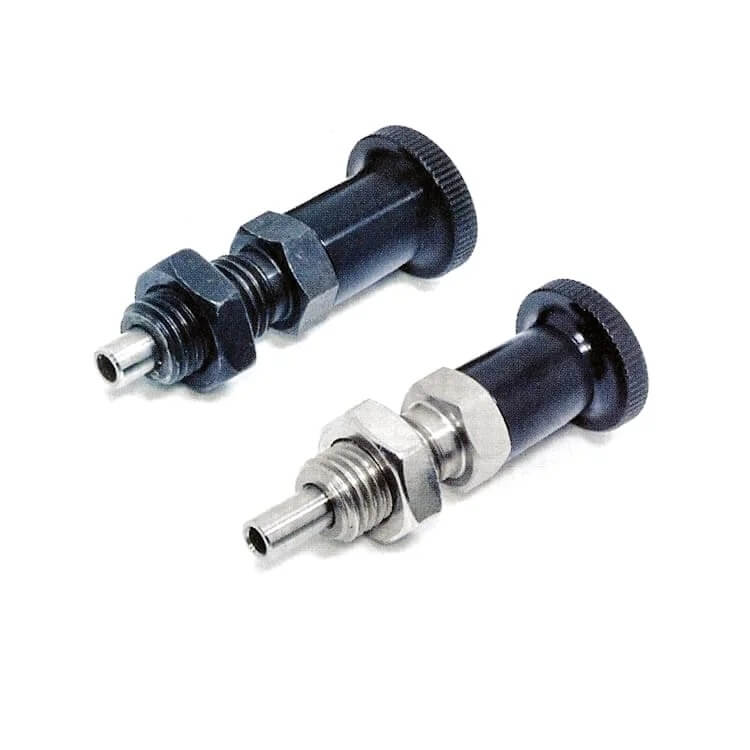
An indexing plunger is a spring-loaded locating pin that aligns, locks, and secures moving components in a mechanical assembly. Five specs decide whether the one you ordered is the right one: pin diameter, locking mechanism, mounting style, actuation handle, and material grade. The one almost nobody checks is the flexural side-load rating, which falls off a cliff the moment your mounting bore tolerance leaves any meaningful gap.
The Five Selection Levers That Actually Matter
Catalogs will give you a dozen filters. Five of them dictate roughly 90% of how the part performs. Pin diameter controls shear strength. Locking type determines high-cycle wear. Mounting style governs alignment recovery. Actuation style drives whether the operator actually uses it correctly. Material grade decides whether it survives the environment you put it in. [Source: elesa-ganter.com/products/indexing-elements]
For ballpark sizing: typical indexing plungers run from 3 mm to 16 mm pin diameters (1/8″ to 5/8″). Threads scale with that — M6×0.75 on the compact end, up to M24×2.0 on heavy-duty units. [Source: ganternorm.com/en/products]
Sizing the Pin — Diameter, Engagement, and Why Most Engineers Oversize
Pin diameter selection comes down to anticipated shear force. Elesa+Ganter’s structural data calculates pure shear capacity at 80% of the material’s yield limit ($R_e$) to keep the pin from taking a permanent set. A 6 mm pin in 1.4305 (AISI 303) stainless with an $R_e$ of 580 N/mm² gets you a pure shear strength of 13,120 N. [Source: elesa-ganter.nl/computing-strength-indexing-plungers]
Here’s the part the spec sheet doesn’t yell about. Pure shear assumes zero gap between the guide bushing and the opposing bore. Almost no real assembly has zero gap. Leave 2 mm of clearance and the pin isn’t in shear anymore — it’s a cantilevered beam in flexure. Run the bending math ($F_b = R_{p0.2} \times W / l$) and that same 5 mm steel pin with 2 mm of standoff drops to 3,430 N permissible. From “ten thousand newtons” to “thirty-four hundred.” That’s the gap (no pun intended) between catalog numbers and what your fixture actually sees. It’s also why every experienced fixture designer I’ve worked with quietly oversizes pins. [Source: jwwinco.com/en-us/products/indexing-plungers]
General rule: spec a minimum engagement depth of 1.5× the pin diameter, and size the pin assuming flexural load — not pure shear — unless you’re holding micron-level bore tolerances. You’re not.
Locking vs Non-Locking vs Rest Position — The Decision Most People Get Wrong
Three mechanical variants: non-locking, locking with rest position, and locking without rest position. Most designers default to “locking with rest position” because being able to hold the pin retracted feels like a free upgrade.
It isn’t. Plungers with a rest position make the operator pull the knob and twist it (90° on standard models, 30° on compact units like the Halder Mini Index 22110) to seat the pin in a notched catch. [Source: halderusa.com/index-plungers-22110.0026]
Every cycle, friction works on that detent. Over thousands of cycles the notch wears, the pin starts to slip out of rest, and now you’ve got a fixture that intermittently drops a pin into a moving part. If your operator’s job is just to click a workpiece into the next station and let go, a non-locking plunger removes the wear surface entirely. Different mechanism, longer life. Pick on duty cycle, not on which one has more features.
Body Style and Mounting — Threaded, Press-Fit, or Flange?
Mounting style changes how serviceable the part is and how tight your bore tolerances need to be.
- Threaded bodies. The default. Fine threads (M8×0.75, M10×1.0) let you dial depth in. If you’re threading into aluminum and the fixture sees vibration, the threads will eventually gall or back out — use a lock nut or a medium-strength threadlocker. Don’t skip this.
- Press-fit bodies. Smooth OD, pressed straight into the host. Bore tolerance has to be right (H7) or you’ve got a problem you can’t fix without re-boring.
- Flange mounts. Plate-style, two SHCS through the flange. Best choice when the wall is too thin for the threaded body to grab enough material to resist side load.
For the receiving indexing bore — the hole the pin actually drops into — manufacturers spec H7. Plunger pins are typically ground -0.02 to -0.04 mm undersized to give clearance without sloppy fit. [Source: elesa-ganter.nl/indexing-plungers-tolerances]
Knob, Pull-Ring, T-Handle, or Finger Loop — Operator Ergonomics Beats Spec Sheets
Actuation hardware dictates whether your operator actually uses the plunger the way you designed it.
A standard mushroom knob is fine for bare hands. Put a glove on the operator, or a film of way oil on their fingers, and a mushroom knob becomes the most-cursed part of the fixture.
The other thing that bites people: standard knobs are PA 6 nylon, and PA 6 starts breaking down structurally above 80°C (176°F). For a 250°C application — say, a fixture sitting next to an injection mold — you need an all-steel pull-ring like the Halder EH 22120. [Source: halderusa.com/index-plungers-eh-22120]
If the application needs high spring force to resist vibration, go to a T-handle. Heavy-duty units like the Carr Lane CL-10-HRPM hit around 4.9 lbs (21.8 N) of final end force, which is fine until you ask someone to pull it three hundred times a shift on a mushroom knob. Their fingertips will hate you. For tight spaces with no room for outward pull, push-lock plungers like the Halder 22111 use an internal biros mechanism — push to extend, push again to retract. [Source: carrlane.com/hand-retractable-plungers]
Material and Finish — Beyond “Just Use Stainless”
Environment dictates material. Standard steel plungers come with a black-oxide finish — fine for dry indoor air, useless the second any fluid hits it consistently.
“Stainless steel” on a catalog page hides a real distinction. Most stainless plungers are 1.4305 (AISI 303). Machines beautifully, handles atmospheric moisture, and that’s about it. The moment you’re in a washdown environment, or a food-contact line where the cleaning chemistry is chloride-based, 303 will pit. You want 1.4401 (AISI 316). [Source: rs-online.com/washdown-plungers]
Welding application: don’t put a plastic knob anywhere near it. Spatter lands on PA 6 and fuses the mechanism shut. Spec full-metal plungers with a nitrided pin.
When NOT to Use an Indexing Plunger
Indexing plungers are wrong for high-frequency automation, extreme vibration, or sub-micron repeatability.
- High-precision repeatability. Standard indexing plungers run an H7 bore, which is up to +0.015 mm of clearance around the pin. If your fixture needs exact repeat, use ball lock pins — they hold around ±0.005 mm. [Source: fa-zcwj.com/spring-plunger-guide]
- High-cycle automation (>1M cycles). Manual plungers depend on coil springs and a human hand. In a robot cell past a million cycles, you want pneumatic shot pins or an automated system like the Mechline Pro Crane (3/8″ pneumatic connector) that takes the operator out of the loop entirely. [Source: roni.com/mechline-pro]
- Continuous heavy side load. Plungers are locators, not axles.
Specification Checklist Before You Order
Eight variables to lock down before the PO goes out. Worked example, manual robotic tool changer:
- Pin diameter (Ø): 8 mm
- Pin engagement length: 12 mm (1.5× dia)
- Side load expected: 150 N flexural — within 303 SS limits
- Cycles/day: 50, low cycle
- Environment: machining coolant present
- Mounting: M16×1.5 fine thread
- Actuation: T-handle, gloved operators
- Material: 1.4305 (AISI 303) body and pin
Decoding a part number: Halder 22110.0026 is the mini index series (22110), steel body with a 5 mm 1.4305 pin, PA 6 thermoplastic knob, M8 thread. Once you’ve read a few of these, the structure is obvious. [Source: halderusa.com/mini-indexes-22110.0026]
FAQ
1. What’s the difference between an indexing plunger and a spring plunger?
An indexing plunger has a manual handle — knob, ring, T-handle — that the operator actively pulls to retract the pin. A spring plunger is passive: a rolling ball or rounded nose that depresses on its own when something pushes against it laterally. Different jobs. Spring plungers are detents. Indexing plungers are locators you commit to.
2. What size indexing plunger do I need?
Size the pin so anticipated side load stays under the flexural yield limit, not the pure shear number. Engagement depth at least 1.5× pin diameter into the mating bore.
3. Can indexing plungers handle side load?
Yes, but capacity collapses with bore clearance. A 5 mm steel pin handles 10,000+ N in pure shear and under 3,500 N once a 2 mm gap puts it in bending. The number on the catalog page assumes a fit you don’t have.
4. How long does an indexing plunger last?
Depends on the locking mechanism and the side load. Rest-position units wear faster on the notched catch.
Author Bio: Written by Robin who is a mechanical design engineer specializing in workholding and fixture design for automated manufacturing cells.